Tilde’s artificial intelligence marks a new era for translation in European languages
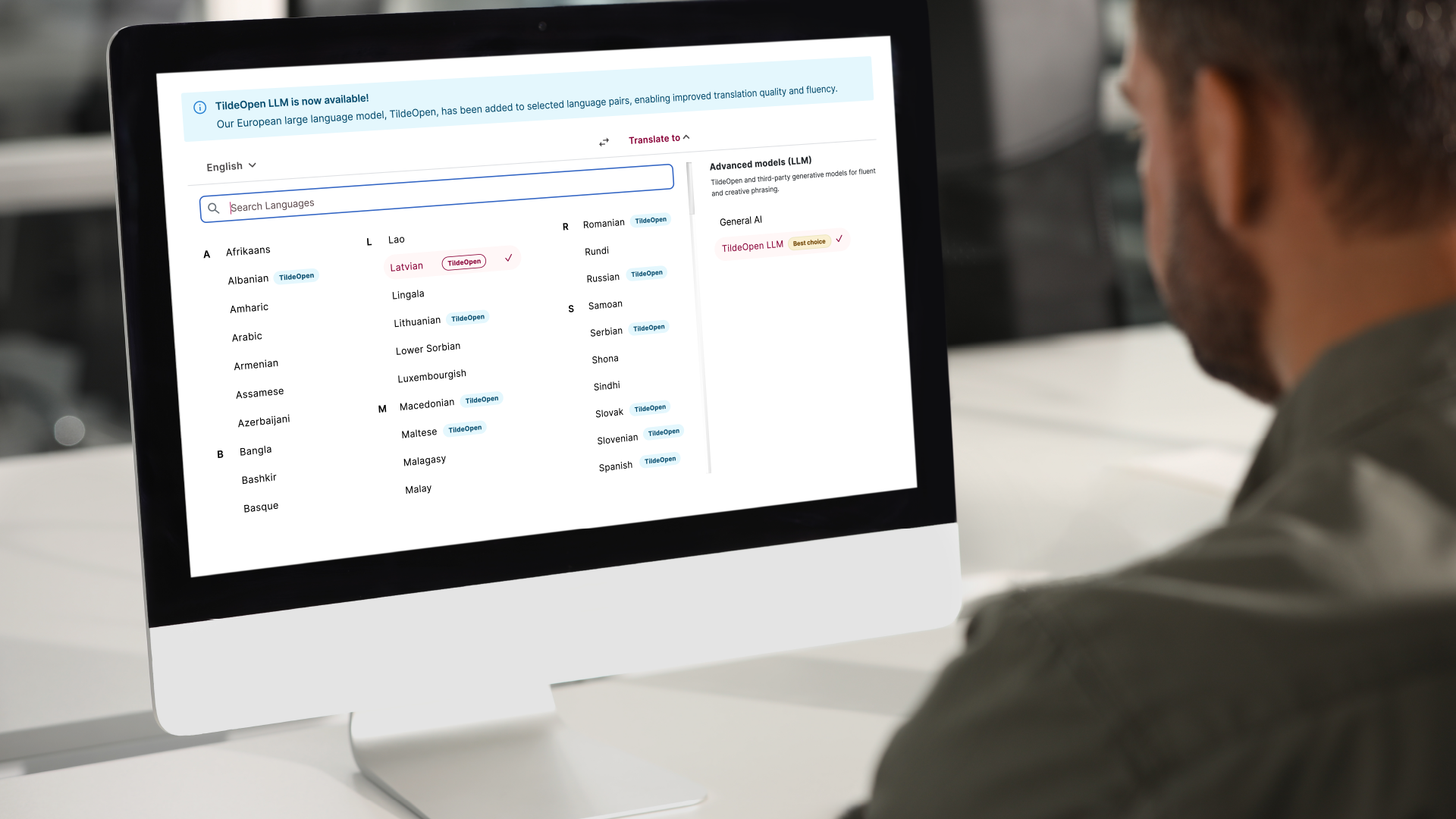
Tilde, the language technology company from Latvia, has adapted its large language model TildeOpen LLM for translation and integrated it into a machine translation platform that provides reliable high-quality translations into 34 European languages. Until now, the model was mainly a significant scientific achievement in the development of artificial intelligence for European languages, but it had not yet been adapted for everyday use by a wider audience. Now, it is available to the public for both private translation needs and daily work.
Starting today, anyone can use the translation platform, which provides exceptionally high-quality and secure translation into 34 European languages, including Latvian, Lithuanian, and Estonian, and provides for accurate use of terminology and more natural, fluent sentences, reducing the post-editing workload of the machine-translated texts.
TildeOpen provides quality that is competitive compared to much larger global models, such as ChatGPT-4.1, even though it is about 60 times smaller. Detailed results of the comparative tests are available in the ranking of large language models TildeBench.
Organisations can deploy TildeOpen on premises or in Europe-based clouds, thus maintaining full control of their data. Unlike many global AI solutions, the data is never transferred outside Europe. This is especially important for public bodies and enterprises that handle sensitive information. At the same time, the model can be customised to suit individual needs, thus providing particularly accurate and reliable translations.
“The integration of TildeOpen into machine translation is a significant step in enabling the practical use of artificial intelligence for European languages. Our objective is to ensure that high-quality language technology is not only accessible, but also reliable for everyday work,” says Artūrs Vasiļevskis, CEO of Tilde.
TildeOpen was published as an open-source foundational model for European languages on the Hugging Face platform in autumn 2025. It was developed in Tilde’s research laboratory on behalf of the European Commission. The model has 30 billion parameters and is trained on hundreds of billions of words in European languages, including 29 billion Latvian text units. This is the largest known amount of data used in the development of Latvian artificial intelligence. The model was developed after winning the Large AI Grand Challenge contest organised by the European Commission, using the LUMI supercomputer in Finland.
Curious about implementing AI in your organisation?
Contact us today and see how our solutions can improve your workflow.